
As featured by Amphenol Communication Solutions:
April 27, 2026
As data rates scale to 224 Gb/s and beyond, system designers are increasingly turning to cable-based connector architectures such as OverPass™ to overcome the physical limitations of traditional PCB routing. By moving high-speed signals off the PCB and into controlled twinax cable assemblies, these architectures reduce loss, improve channel reach, and enable next-generation performance in switches, accelerators, and high-performance computing systems.
While cable-based interconnect improves the production signal path, engineers still face a critical challenge during development: gaining accurate, repeatable electrical access to those high-speed channels for test and validation. Reliable test access plays a central role in ensuring successful implementation.
This need evolves as systems move from concept to validation.
During silicon bring-up, the goal is simple: understand what the channel actually looks like. At this stage, device, package, and board interactions are first observed together. Any reflections or loss introduced by the test interface become part of the measurement, potentially masking true silicon performance. A clean, well-controlled transition is essential to establish a reliable baseline.
In channel characterization, focus shifts to extracting accurate S-parameters and frequency behavior. Small discontinuities at the test interface can distort return and insertion loss, corrupting de-embedding models. In OverPass™ architectures, where the production path is optimized in cable, poor test transitions can negate that advantage and produce misleading channel models.
During equalization and system tuning, sensitivity increases further. At 224G, tuning depends directly on the measured channel response. If that data includes test artifacts, systems are optimized against the wrong target, leading to lab results that don’t translate to real-world performance.
By compliance and validation, consistency becomes critical. Mechanical variability in the test interface, even minor changes in contact geometry or compression, can introduce measurement drift, causing false failures or inconsistent results.
In debug and failure analysis, the test interface must eliminate uncertainty. With tight margins, engineers need confidence that measurements reflect the system, not the connection. A stable interface allows rapid isolation of true root causes.
Across all stages, the requirement is not just signal access, but confidence in the measurement. As OverPass™ optimizes the production path, the test infrastructure must be equally controlled to ensure accuracy and repeatability.
This directly addresses several key issues at 224G and beyond.
Electrical path length is minimized, reducing reflections and ripple that can distort insertion loss and return loss measurements. The transition itself is impedance-controlled, limiting discontinuities and mode conversion at the PCB interface. And because the interface is compression-based rather than soldered or probe-based, it provides consistent contact geometry and force, resulting in highly repeatable measurements across test cycles.
Equally important, TR Multicoax delivers this performance at high channel density, with uniform behavior across lanes. This allows engineers to evaluate full systems, not just individual channels, without introducing skew or channel-to-channel variation from the test interface.
The result is a measurement interface that behaves as a controlled extension of the channel rather than a source of uncertainty. Engineers can accurately characterize and validate OverPass™-based systems while preserving the integrity of the production signal path.
Ardent Concepts plays a key role in this ecosystem by providing high-performance test interconnect solutions that engineers rely on to develop and deploy next-generation systems. By enabling accurate characterization, repeatable validation, and efficient debugging, Ardent Concepts helps ensure the successful implementation of advanced cable-based interconnect architectures.
While cable-based interconnect improves the production signal path, engineers still face a critical challenge during development: gaining accurate, repeatable electrical access to those high-speed channels for test and validation. Reliable test access plays a central role in ensuring successful implementation.
The Critical Role of Test During OverPass™ Development
Across the silicon and system development lifecycle, engineers need direct electrical access to high-speed channels for characterization, validation, and debug using VNAs, BERTs, oscilloscopes, and similar tools.This need evolves as systems move from concept to validation.
During silicon bring-up, the goal is simple: understand what the channel actually looks like. At this stage, device, package, and board interactions are first observed together. Any reflections or loss introduced by the test interface become part of the measurement, potentially masking true silicon performance. A clean, well-controlled transition is essential to establish a reliable baseline.
In channel characterization, focus shifts to extracting accurate S-parameters and frequency behavior. Small discontinuities at the test interface can distort return and insertion loss, corrupting de-embedding models. In OverPass™ architectures, where the production path is optimized in cable, poor test transitions can negate that advantage and produce misleading channel models.
During equalization and system tuning, sensitivity increases further. At 224G, tuning depends directly on the measured channel response. If that data includes test artifacts, systems are optimized against the wrong target, leading to lab results that don’t translate to real-world performance.
By compliance and validation, consistency becomes critical. Mechanical variability in the test interface, even minor changes in contact geometry or compression, can introduce measurement drift, causing false failures or inconsistent results.
In debug and failure analysis, the test interface must eliminate uncertainty. With tight margins, engineers need confidence that measurements reflect the system, not the connection. A stable interface allows rapid isolation of true root causes.
Across all stages, the requirement is not just signal access, but confidence in the measurement. As OverPass™ optimizes the production path, the test infrastructure must be equally controlled to ensure accuracy and repeatability.
How Ardent Concepts Enables OverPass™ Implementation
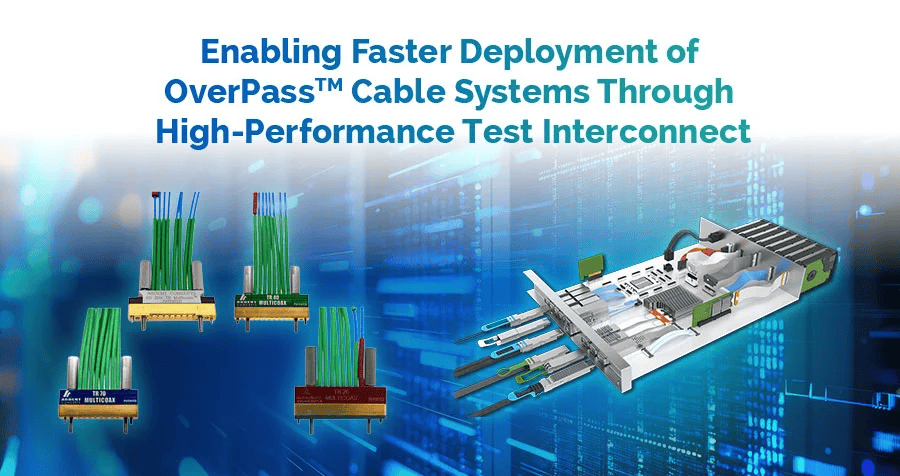
The challenge in testing OverPass™-based systems is not just accessing the signal. It is doing so without reintroducing loss, reflections, and variability that distort the measurement. Ardent Concepts’ TR Multicoax platform is designed to control the transition between the PCB and coaxial measurement environment. Using a compression-mounted, solderless interface, it creates a short, controlled impedance path from the device under test to the instrumentation.This directly addresses several key issues at 224G and beyond.
Electrical path length is minimized, reducing reflections and ripple that can distort insertion loss and return loss measurements. The transition itself is impedance-controlled, limiting discontinuities and mode conversion at the PCB interface. And because the interface is compression-based rather than soldered or probe-based, it provides consistent contact geometry and force, resulting in highly repeatable measurements across test cycles.
Equally important, TR Multicoax delivers this performance at high channel density, with uniform behavior across lanes. This allows engineers to evaluate full systems, not just individual channels, without introducing skew or channel-to-channel variation from the test interface.
The result is a measurement interface that behaves as a controlled extension of the channel rather than a source of uncertainty. Engineers can accurately characterize and validate OverPass™-based systems while preserving the integrity of the production signal path.
Enabling the Transition to Next-Generation Architectures
As cable-based interconnect systems such as OverPass™ become more widely adopted, the importance of high-quality test infrastructure continues to grow. Accurate test access is essential not only for validating performance but also for enabling faster development cycles and improving overall system reliability.Ardent Concepts plays a key role in this ecosystem by providing high-performance test interconnect solutions that engineers rely on to develop and deploy next-generation systems. By enabling accurate characterization, repeatable validation, and efficient debugging, Ardent Concepts helps ensure the successful implementation of advanced cable-based interconnect architectures.
This update references an article originally published by Amphenol Communication Solutions:
Enabling Faster Deployment of OverPass™ Cable Systems Through High-Performance Test Interconnect